My anthropology training taught me that Truth is relative. My upbringing in the Unitarian Universalist faith tradition taught me that Truth is a matter of individual seeking and community decision, a commitment to justice and an openness to changes in understanding. Our cultural obsession with "scientific realities" teaches us that we can prove right and wrong, that there are yes and no answers, that everyone recognizes some realities and to deny those is to lie.
I believe in all of those. This, as one might expect, can be frustrating and confusing.
There are things I know to be true that other people simply do not believe. Neither I nor they are wrong, or silly, or delusional. Our truths are defined by our experiences and our philosophies, our deeply held beliefs and our educations. We must be accepting of these differences.
At the same time, there is also a point when we must insist that our truth is a reality. Cultural relativism has its limits, and if we deny that we deny our reason, humanity, and potential. For example, I hold it as absolutely and undeniably true that queer folk are NOT an abomination. This is not a personal belief, an attempt to preserve my own image and self respect, or a point of condescension. It is a reality, and to reject it is both cruel and foolish. To respect it as my truth and not yours to demean both me and that truth.
How, therefore, can different truths exist in harmony? If respect and tolerance are acts of condescension and acceptance is a charade, how can there ever be an honest gathering of realities. Are those we call close minded and bigoted and those too cynical to consider the viewpoints of others the ones who have the right of it after all?
I don't think so, but it's something I struggle with. Once I open myself to declaring definite truths, am I giving up my declaration of open-mindednesss? Am I losing my status as a respectful participant in the public conversation? When should I stand up for what I believe, and when should I sit down and listen- not because of etiquette but to truly understand? Do I always want to understand?
And what is the difference between a truth and an opinion? Surely there must be a space for opinions- particularly in areas of preference and politics and personal choice. At the same time, it may be insulting to refer to a truth as an opinion, or hyperbole to speak of an opinion as a truth.
I don't want answers, I just want these questions to be out there.
Monday, December 28, 2009

Sunday, December 20, 2009
The Word "Gay"
The word "gay" used as an insult or derogatory descriptor is incredibly poisonous and painful. Every time someone uses it they are actively contributing to homophobia and heteronormality. More than that, they are negatively impacting someone's life. Yes. Every time. Even if they don't "mean it that way". When you call us fruits and nuts, you are insulting us. I don't care if you have a gay friend or a gay uncle- tokenism is and always has been an excuse and nothing more. The phrase "I'm not homophobic, but..." sets off my homophobe-radar faster than nearly anything else.
"That's so gay". What does that mean? It means that you believe queer folk are gross or ridiculous or un-natural or stupid or ungenerous or unattractive or frightening or "square" or just generally un-cool. You're telling everyone in hearing range that you believe that, that you uphold bigotry and are afraid to face your own otherness. It's a squeal of desperation and hatred and fascist close-mindedness.
Unless you identify as queer and everyone who hears you knows you are speaking satirically, it is NOT OKAY to use this word in a negative light. Ever. Whatever your justification. You know better than to use the n-word, yes?
This is not about being politically correct or humoring hyper-sensitive aquaintances. It's about being aware of the history and power of the language you use- words have meaning beyond the obvious and the literal. When you use certain words you are invoking a massive amount of culture, politics, and personal experience. You are not being clever, or ironic, or expressing your position as a post-homophobic wit. You are being a jerk. Every. Single. Time. Even if no-one punches you in the face or gives you a weird look. Even if there are no "gay" people nearby- and since sexuality is fluid and gender expression a complicated and personal question, how can you ever be sure of that? Even if other people agree with you. Actually, especially if other people agree with you.
While we're at it, stop saying things are "lame", too. Bigotry against the otherly-abled is just as annoying. If you've got something to dismiss or deride or insult, use proper profanity or get creative, for goodness sake.
"That's so gay". What does that mean? It means that you believe queer folk are gross or ridiculous or un-natural or stupid or ungenerous or unattractive or frightening or "square" or just generally un-cool. You're telling everyone in hearing range that you believe that, that you uphold bigotry and are afraid to face your own otherness. It's a squeal of desperation and hatred and fascist close-mindedness.
Unless you identify as queer and everyone who hears you knows you are speaking satirically, it is NOT OKAY to use this word in a negative light. Ever. Whatever your justification. You know better than to use the n-word, yes?
This is not about being politically correct or humoring hyper-sensitive aquaintances. It's about being aware of the history and power of the language you use- words have meaning beyond the obvious and the literal. When you use certain words you are invoking a massive amount of culture, politics, and personal experience. You are not being clever, or ironic, or expressing your position as a post-homophobic wit. You are being a jerk. Every. Single. Time. Even if no-one punches you in the face or gives you a weird look. Even if there are no "gay" people nearby- and since sexuality is fluid and gender expression a complicated and personal question, how can you ever be sure of that? Even if other people agree with you. Actually, especially if other people agree with you.
While we're at it, stop saying things are "lame", too. Bigotry against the otherly-abled is just as annoying. If you've got something to dismiss or deride or insult, use proper profanity or get creative, for goodness sake.
Marriage as a Civil Right
Another quote from Nancy F. Cott:
She then goes on to talk about how many minorities have been excluded from this civil right- from slaves to Native Americans (and yes, I still find it ironic to think of that "race" as a minority) to Asians. The history of legislation supporting racist structures has been used to support homophobia in general, but this particular right is one that I find particularly... interesting. Is it that every rights movement has their pivotal representative issue? Equal access to transportation or schools or voting or what have you? Or is there something more going on here?
Cott also says (she's very quotable), "The United States has shown through its national history a commitment to exclusive and faithful monogamy, preferably intraracial. In the name of the public interest and public order, it has furthered this model as a unifying moral standard."
So the Gay and Lesbian movement has been pounding out the message that male-male and female-female couples are just like straight couples. That the only real difference is that of sex. In this era of female empowerment and male sensitivity, are heterosexual couples really all that different from homosexual ones?
What troubles me, of course, is that I am not a Gay and Lesbian activist. I am a Queer activist. And I am not willing to stop questioning at this level. Yes, marriage equality is important, yes it may represent and even herald a larger change, but... how can we ignore that this is a larger issue? Why must we pretend that we are all the same? Perhaps that's the smart thing to do, but is it the right thing?
That's the trouble with advocacy work- doing what's smart or appropriate is not always doing what's right, and how do you decide what's most important?
Another thing- is the core of this problem that we are asking people to change themselves? Isn't that always the hard part of social change, asking for beliefs to shift? Asking people to be a little less comfortable? Maybe that's what bothers me about the Gay and Lesbian stance- they are insisting that no one would be made less comfortable, and I think it's that's nonsense. But then, I'm a troublemaker. And the Christian Western European political roots of our institution of marriage make me cranky- it's a specific historical legacy, nothing natural or inherently moral about it.
Marriage law exists because regimes want to "prescribe marriage rules to stabilize the essential activities of sex and labor and their consequences, children and property" (Cott, p 6). So are we upset because this destabilizes the concept of men as sperm providers and women as wombs? That our value as individuals is dictated by our ability to procreate, rather than to parent or serve the community or accumulate property? Somehow I don't think sexual orientation has anything to do with our ability or tendency to contribute to our materialistic consumer economy, and no one who has researched the roles of queers as parents and community members believes them to be in any way inferior. So what, exactly, is the problem?
Ach, well, it's a big complicated mess. And no, that is NOT my last word on the subject.
Whether or not marriage is as natural as is often claimed, entry to the institution is bound up with civil rights. Marriage is allowed or disallowed by legislators' and judges' decisions. The separate states from Main to California [ironic choice of geographical distinction, yes?], which have the power to regulate marital institutions as part of their authority over the local health, safety, and welfare, determine who gains admittance... By incriminating some marriages and encouraging others, marital regulations have drawn lines among the citizenry and defined what kings of sexual relations and which families will be legitimate. (p. 4, Public Vows)
She then goes on to talk about how many minorities have been excluded from this civil right- from slaves to Native Americans (and yes, I still find it ironic to think of that "race" as a minority) to Asians. The history of legislation supporting racist structures has been used to support homophobia in general, but this particular right is one that I find particularly... interesting. Is it that every rights movement has their pivotal representative issue? Equal access to transportation or schools or voting or what have you? Or is there something more going on here?
Cott also says (she's very quotable), "The United States has shown through its national history a commitment to exclusive and faithful monogamy, preferably intraracial. In the name of the public interest and public order, it has furthered this model as a unifying moral standard."
So the Gay and Lesbian movement has been pounding out the message that male-male and female-female couples are just like straight couples. That the only real difference is that of sex. In this era of female empowerment and male sensitivity, are heterosexual couples really all that different from homosexual ones?
What troubles me, of course, is that I am not a Gay and Lesbian activist. I am a Queer activist. And I am not willing to stop questioning at this level. Yes, marriage equality is important, yes it may represent and even herald a larger change, but... how can we ignore that this is a larger issue? Why must we pretend that we are all the same? Perhaps that's the smart thing to do, but is it the right thing?
That's the trouble with advocacy work- doing what's smart or appropriate is not always doing what's right, and how do you decide what's most important?
Another thing- is the core of this problem that we are asking people to change themselves? Isn't that always the hard part of social change, asking for beliefs to shift? Asking people to be a little less comfortable? Maybe that's what bothers me about the Gay and Lesbian stance- they are insisting that no one would be made less comfortable, and I think it's that's nonsense. But then, I'm a troublemaker. And the Christian Western European political roots of our institution of marriage make me cranky- it's a specific historical legacy, nothing natural or inherently moral about it.
Marriage law exists because regimes want to "prescribe marriage rules to stabilize the essential activities of sex and labor and their consequences, children and property" (Cott, p 6). So are we upset because this destabilizes the concept of men as sperm providers and women as wombs? That our value as individuals is dictated by our ability to procreate, rather than to parent or serve the community or accumulate property? Somehow I don't think sexual orientation has anything to do with our ability or tendency to contribute to our materialistic consumer economy, and no one who has researched the roles of queers as parents and community members believes them to be in any way inferior. So what, exactly, is the problem?
Ach, well, it's a big complicated mess. And no, that is NOT my last word on the subject.
Friday, December 18, 2009
Marrying the Princess Bride
"Mawwaige. Mawwaige is what bwings us together, today. Mawwaige, that blessed arrangement, that dweam within a dweam"
"Stand your ground, men, stand your ground!"
Those are the opening words of the climax of Princess Bride- the wedding scene. What it's all been building up to. It's the beginning of a farce. Almost immediately afterward Westley invalidates the ceremony because Buttercup didn't love the prince and never had sex with him- she never said "I do". He tells her she did NOT inadvertently marry herself off, that what happened didn't count. Interestingly, the prince wasn't particularly interested in being married to her, either. He just wanted a martyr to base a war upon. The wedding of the princess bride doesn't fit into the American concept of marriage as a consensual agreement or our concept of the legal ceremony- they skipped all the romantic bits! It was just about power and hurting people! That's not what a wedding is supposed to be about!
In that movie Love is the most important thing in life. Never mind practicalities and promises and whatnot- True Love is something you should abandon everything for and damn the consequences. Interestingly, I think the book serves as a satire of modern romantic ideals and it's the movie where Hollywood switches everything around to uphold this cultural norm.
"True love is the greatest thing in the world".
Do we really believe that, or are we more likely to agree with this xkcd cartoon?

Points of disagreement: He was being held captive during your year of mourning (yes, it was ONE YEAR, during which he was constantly reminded that he could be killed at any moment), and the point of being a dread pirate is that you DON'T kill people- you intimidate through reputation, like most of the pirates of the golden age (and yes, there really was a dread pirate roberts, though they didn't call him that and so far as we know it really was just one person).
Maybe I'm defensive because the movie made me want to be Westley, and I think Buttercup is an idiot. Maybe I just desperately want to believe in the idea of true love.
Maybe the moral of the story is that marriage is a farce and love is moronic.
Satire is supposed to be cynical, I suppose.
And yes, I do have some personal baggage on this subject, it would be ridiculous to deny that. I don't want marriage to be a farce or love to be moronic, I don't want to think of Westley as a dick. Still, I think it's good to ponder the meanings behind the campy classic.
"Stand your ground, men, stand your ground!"
Those are the opening words of the climax of Princess Bride- the wedding scene. What it's all been building up to. It's the beginning of a farce. Almost immediately afterward Westley invalidates the ceremony because Buttercup didn't love the prince and never had sex with him- she never said "I do". He tells her she did NOT inadvertently marry herself off, that what happened didn't count. Interestingly, the prince wasn't particularly interested in being married to her, either. He just wanted a martyr to base a war upon. The wedding of the princess bride doesn't fit into the American concept of marriage as a consensual agreement or our concept of the legal ceremony- they skipped all the romantic bits! It was just about power and hurting people! That's not what a wedding is supposed to be about!
In that movie Love is the most important thing in life. Never mind practicalities and promises and whatnot- True Love is something you should abandon everything for and damn the consequences. Interestingly, I think the book serves as a satire of modern romantic ideals and it's the movie where Hollywood switches everything around to uphold this cultural norm.
"True love is the greatest thing in the world".
Do we really believe that, or are we more likely to agree with this xkcd cartoon?
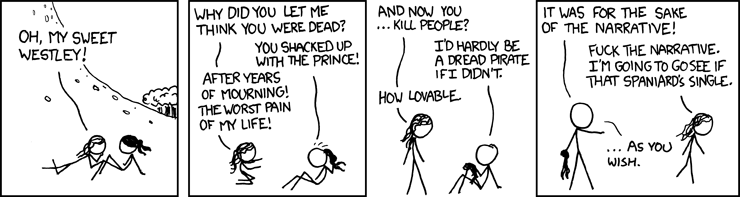
Points of disagreement: He was being held captive during your year of mourning (yes, it was ONE YEAR, during which he was constantly reminded that he could be killed at any moment), and the point of being a dread pirate is that you DON'T kill people- you intimidate through reputation, like most of the pirates of the golden age (and yes, there really was a dread pirate roberts, though they didn't call him that and so far as we know it really was just one person).
Maybe I'm defensive because the movie made me want to be Westley, and I think Buttercup is an idiot. Maybe I just desperately want to believe in the idea of true love.
Maybe the moral of the story is that marriage is a farce and love is moronic.
Satire is supposed to be cynical, I suppose.
And yes, I do have some personal baggage on this subject, it would be ridiculous to deny that. I don't want marriage to be a farce or love to be moronic, I don't want to think of Westley as a dick. Still, I think it's good to ponder the meanings behind the campy classic.
Tolkien's Endings
In the DVD extras of the Return of the King they tell the story of a famous actor who left the premier of the movie early to go and warm up the car for his family. When asked why he left he said there were "too many endings".
I think part of the brilliance of Tolkien's work is how messy it is. He didn't follow the rules and conventions of literature- his books shouldn't have worked. The groups of characters get totally disconnected from each other, the time line's all screwy, there are characters and events that don't really help build the plot at all (cough, Tom Bombadil, cough). Reading the books is a bit of an endurance test... it almost seems more a collection of dramatic statements and scenery. But a lot of us love them all the same.
The ending of the book is what fascinates me. My biggest grievance with the films is that they left out my favorite parts- the encounter with Tom Bombadil and the Scouring of the Shire. Actually, I believe the Scouring of the Shire was the most important part of the story. I mean, how often in fiction does the hero go off to save the world and come home to find everything a huge mess? That seems much more like what would happen in real life! And without the Scouring of the Shire the hobbit's homecoming is a complete letdown. Maybe there's a point to that, of course- our home communities may be the last ones to recognize our achievements if they don't understand them- but I always feel that something is missing. Tolkien does something wonderful for those characters when he lets them come home and save the day- he makes their home the most important thing in their lives and its rescue the point that all the character building they've been doing lead up to. He lets them take on responsibility among their own people, and confront the complications of their community's connection to a wider world. Maybe a part of this is that I always liked Merry and Pippin more than Frodo and found their journey more interesting. Maybe I just think it's stupid that nothing bad would ever happen to the Shire.
Anyway, what I'm trying to say is that I love how convoluted the end of Lord of the Rings is. In life, when do we ever get conclusive endings to our stories? To an extent we make those endings for ourselves, and we all end things at different times. Everyone says goodbye and it's over in their own fashion and on their own timeline. I love that Tolkien honors that, and doesn't tie off everyone's story neatly all at once.
I think part of the brilliance of Tolkien's work is how messy it is. He didn't follow the rules and conventions of literature- his books shouldn't have worked. The groups of characters get totally disconnected from each other, the time line's all screwy, there are characters and events that don't really help build the plot at all (cough, Tom Bombadil, cough). Reading the books is a bit of an endurance test... it almost seems more a collection of dramatic statements and scenery. But a lot of us love them all the same.
The ending of the book is what fascinates me. My biggest grievance with the films is that they left out my favorite parts- the encounter with Tom Bombadil and the Scouring of the Shire. Actually, I believe the Scouring of the Shire was the most important part of the story. I mean, how often in fiction does the hero go off to save the world and come home to find everything a huge mess? That seems much more like what would happen in real life! And without the Scouring of the Shire the hobbit's homecoming is a complete letdown. Maybe there's a point to that, of course- our home communities may be the last ones to recognize our achievements if they don't understand them- but I always feel that something is missing. Tolkien does something wonderful for those characters when he lets them come home and save the day- he makes their home the most important thing in their lives and its rescue the point that all the character building they've been doing lead up to. He lets them take on responsibility among their own people, and confront the complications of their community's connection to a wider world. Maybe a part of this is that I always liked Merry and Pippin more than Frodo and found their journey more interesting. Maybe I just think it's stupid that nothing bad would ever happen to the Shire.
Anyway, what I'm trying to say is that I love how convoluted the end of Lord of the Rings is. In life, when do we ever get conclusive endings to our stories? To an extent we make those endings for ourselves, and we all end things at different times. Everyone says goodbye and it's over in their own fashion and on their own timeline. I love that Tolkien honors that, and doesn't tie off everyone's story neatly all at once.
Marriage and Gender
Nancy F Cott writes in the introduction to her book Public Vows that:
I find this argument adds a fascinating frame to the marriage equality debate currently underway in this country. Isn't the framing of this question of gender and marriage the major force behind the debate? If marriage is about a husband who acts as the "family head and economic provider, his wife the dependent partner," then taking gender out of the equation for who can or cannot be married means setting all of our gender roles on their heads. That these roles are always shifting is something that I can understand viewing as a crisis. If what is "right" is that the man goes out and makes money and the woman keeps the hearth fire going, then clearly this is already upset by the amount of career women and house husbands out there. So clinging to the definition of marriage as a public union of man and woman can be seen as a desperate attempt to preserve a "safe" concept of home and family.
"Safe" means knowing who you are and what you're supposed to do with your life- how you're supposed to relate to those you're romantically attracted to and who you're allowed to be romantically attracted to. I could rail at length about how this is a preservation of the patriarchy and a generally sexist system, but at the same time I think it's important to acknowledge that there is some understandable fears involved here. Identity crises are real and terrifying things. NO ONE wants to have their life and their life choices invalidated. Are we saying that those who've chosen to build who they are and how they live around the concept of the "traditional" family are delusional, out of step, or hopelessly bigoted? I can't think of anyone who would agree, yet I wonder if that's how our efforts towards equality might be perceived.
Marriage has come to represent a happy ending- the epitome of happily ever after. A wedding is the golden moment of public approval and personal commitment- the community honoring that a couple is doing something right and two people promising each other "I will be here, you will never be lonely again". Giving queer couples that moment and that happily ever after changes the way everyone must view who they are. It makes marriage about something other than husband and wife- the provider and the dependent in their tidy pattern of life. That it was never actually very tidy is beside the point- it was a dream of tidiness. No one likes having their dreams rent away.
Defining marriage is a tricky thing. Anthropology finally decided on sexual access as the determining factor, but where does that leave our pretty dreams? For us I believe it is a promise and a confirmation, a declaration and a sacred institution. Indeed the term "institution" is thrown about quite a bit. Culturally we mock and uphold it, treasure and struggle and mourn its changing patterns. What does it mean when the divorce rate goes up, when people get married older or younger, when non-married couples build families without that legal designation? There are all sorts of studies about the benefits of marriage, how it makes you live longer and keeps your children happier. I don't think we need studies to see all of the legal benefits of being married- or even the social ones.
What does it mean to be unmarried? To be a bachelor or an old maid or "living in sin"? Does it make a woman a (wait for it)... Lesbian? A bachelor a closeted homosexual (or a sex fiend)? Does it mean a person is too unethical or uncommitted, too weak or unattractive or foolish or immature to handle the proper social role of being married? We've tried to reclaim that status- we strut about the freedom of the single person as we laud the advantages of youth. Yet still our culture understands that being unmarried is being frivolous and not taking life and relationships seriously. It's an automatic (if generally quiet) social stigma. When people choose not to be married they are deliberately stepping outside of the perceived social norm.
So if queer couples are not allowed to wed, they must be socially stigmatized. No matter how it's phrased or conditioned we know that rings true. It's a slap down, a belittlement, and a denial. Ultimately this is not about legal rights or public ceremonies or a preservation of the family. It's about the dream and the the hope of a happy ending. In the words of Harvey Milk, "this is our lives we're fighting for". What's a life without hope? Who wants to live with no chance of social acceptance or personal contentment, with stigma and disgust and condescension?
This is why it's so hugely important that Ellen DeGeneres is a success, that the film DEBs be widely viewed, that pride parades make the news. We are remaking the story, saying that we are not pedophiles and failures and lonely closeted recluses but people with a right to stand up and state who we love. Isn't that what a wedding is all about? Standing up and saying who you love? Isn't that what the queer movement is all about, refusing to be silent? Saying we will not hide, we will not despair, we will reach for hope and happiness and our happily ever after?
In challenging gender within the institution of marriage we are challenging cultural norms and expectations. It can't be denied that this is a scary thing to do. Do we give in to our fears of change? Do we uphold our too-small boxes of identity and inclusion, our narrow ideas of who and what a person can be? Or do we stand on the side of love and diversity and doing what's right even when it's hard? What is right? Doesn't religion say that's love and hope and understanding? Are we willing to believe in that or do we prefer to cling to the story of patriarchal heteronormal life?
I say gender roles are a lot of crap. I say let go of your fear and come stand on the side of love. "You gotta give 'em hope!"
The whole system of attribution and meaning that we call gender relies on and to a great extent derives from the structuring provided by marriage. Turning men and women into husbands and wives, marriage has designated the ways both sexes act in the world and the reciprocal relation between them. The unmarried as well as the married bear the ideological, ethical, and practical impress of the marital institution, which is difficult or impossible to escape.
I find this argument adds a fascinating frame to the marriage equality debate currently underway in this country. Isn't the framing of this question of gender and marriage the major force behind the debate? If marriage is about a husband who acts as the "family head and economic provider, his wife the dependent partner," then taking gender out of the equation for who can or cannot be married means setting all of our gender roles on their heads. That these roles are always shifting is something that I can understand viewing as a crisis. If what is "right" is that the man goes out and makes money and the woman keeps the hearth fire going, then clearly this is already upset by the amount of career women and house husbands out there. So clinging to the definition of marriage as a public union of man and woman can be seen as a desperate attempt to preserve a "safe" concept of home and family.
"Safe" means knowing who you are and what you're supposed to do with your life- how you're supposed to relate to those you're romantically attracted to and who you're allowed to be romantically attracted to. I could rail at length about how this is a preservation of the patriarchy and a generally sexist system, but at the same time I think it's important to acknowledge that there is some understandable fears involved here. Identity crises are real and terrifying things. NO ONE wants to have their life and their life choices invalidated. Are we saying that those who've chosen to build who they are and how they live around the concept of the "traditional" family are delusional, out of step, or hopelessly bigoted? I can't think of anyone who would agree, yet I wonder if that's how our efforts towards equality might be perceived.
Marriage has come to represent a happy ending- the epitome of happily ever after. A wedding is the golden moment of public approval and personal commitment- the community honoring that a couple is doing something right and two people promising each other "I will be here, you will never be lonely again". Giving queer couples that moment and that happily ever after changes the way everyone must view who they are. It makes marriage about something other than husband and wife- the provider and the dependent in their tidy pattern of life. That it was never actually very tidy is beside the point- it was a dream of tidiness. No one likes having their dreams rent away.
Defining marriage is a tricky thing. Anthropology finally decided on sexual access as the determining factor, but where does that leave our pretty dreams? For us I believe it is a promise and a confirmation, a declaration and a sacred institution. Indeed the term "institution" is thrown about quite a bit. Culturally we mock and uphold it, treasure and struggle and mourn its changing patterns. What does it mean when the divorce rate goes up, when people get married older or younger, when non-married couples build families without that legal designation? There are all sorts of studies about the benefits of marriage, how it makes you live longer and keeps your children happier. I don't think we need studies to see all of the legal benefits of being married- or even the social ones.
What does it mean to be unmarried? To be a bachelor or an old maid or "living in sin"? Does it make a woman a (wait for it)... Lesbian? A bachelor a closeted homosexual (or a sex fiend)? Does it mean a person is too unethical or uncommitted, too weak or unattractive or foolish or immature to handle the proper social role of being married? We've tried to reclaim that status- we strut about the freedom of the single person as we laud the advantages of youth. Yet still our culture understands that being unmarried is being frivolous and not taking life and relationships seriously. It's an automatic (if generally quiet) social stigma. When people choose not to be married they are deliberately stepping outside of the perceived social norm.
So if queer couples are not allowed to wed, they must be socially stigmatized. No matter how it's phrased or conditioned we know that rings true. It's a slap down, a belittlement, and a denial. Ultimately this is not about legal rights or public ceremonies or a preservation of the family. It's about the dream and the the hope of a happy ending. In the words of Harvey Milk, "this is our lives we're fighting for". What's a life without hope? Who wants to live with no chance of social acceptance or personal contentment, with stigma and disgust and condescension?
This is why it's so hugely important that Ellen DeGeneres is a success, that the film DEBs be widely viewed, that pride parades make the news. We are remaking the story, saying that we are not pedophiles and failures and lonely closeted recluses but people with a right to stand up and state who we love. Isn't that what a wedding is all about? Standing up and saying who you love? Isn't that what the queer movement is all about, refusing to be silent? Saying we will not hide, we will not despair, we will reach for hope and happiness and our happily ever after?
In challenging gender within the institution of marriage we are challenging cultural norms and expectations. It can't be denied that this is a scary thing to do. Do we give in to our fears of change? Do we uphold our too-small boxes of identity and inclusion, our narrow ideas of who and what a person can be? Or do we stand on the side of love and diversity and doing what's right even when it's hard? What is right? Doesn't religion say that's love and hope and understanding? Are we willing to believe in that or do we prefer to cling to the story of patriarchal heteronormal life?
I say gender roles are a lot of crap. I say let go of your fear and come stand on the side of love. "You gotta give 'em hope!"
Monday, December 14, 2009
Feminism
I don't know that I believe feminism is not so much about being proud to be a girl or a woman as dismissing the idea that gender is an indication of worth (sorry for the convoluted nature of that sentence). Perhaps I'd like to believe that, because I'm also a queer activist and I think male gender roles are as much a crock of shit as the female ones. But when I act as a feminist I am upholding "feminine" qualities- being emotive and nurturing and cooperative instead of closed off and competitive. Do I believe these are necessarily the natural properties of womanhood, or that women are in some way superior? No. And I've gotten as much "emotional violence" from men as women (though women are better trained for it), so I don't think women are naturally passive-aggressive back-stabbers, either. Nor do I think anyone should be meek, or condescended to, or dis-enfranchised, or mocked because of their gender or sexuality. Be who you are, and stand up tall within your individuality.
Feminism is about pride, about respect for a different view and different skills, about empowerment. I am here, I will not be quiet!
Feminism is about pride, about respect for a different view and different skills, about empowerment. I am here, I will not be quiet!
What it Means to be Queer
To be a Queer is to reject the tidy boxes, labels, and binaries of gender, sexuality, and sexual orientation. More then that, it is to stand in solidarity with everyone who feels marginalized. It is to validate the diversity of identity and experience. Love is never evil, you are who you are, we are none of us a stereotype or a sin or an abomination. I am never "just like you" because we are all of us different. So no, I am not a Lesbian or Bisexual or Straight. I am not a Boy or a Girl, and I wince every time I check the Female box on a form. If we're looking at the spectrum of all of this, I'd say I lean towards the purple end of the spectrum of sexual orientation and the feminine end of gender, that I'm pretty darn mono-amorous and certainly far from asexual.
Mostly I say I'm myself, and I'm Queer.
Mostly I say I'm myself, and I'm Queer.
Wish List
Dear Santa:
For Christmas I would like more soda ash, several yards of white rayon fabric, and a rainbow umbrella.
Love,
Me
For Christmas I would like more soda ash, several yards of white rayon fabric, and a rainbow umbrella.
Love,
Me
My Gender
I could go on at great length about the concept of gender- how I think the gender binary we endorse is a lot of crap and everyone exists in their own space on a spectrum. I'm a queer activist, after all, I've given this a lot of thought. But at the moment I'm thinking about where I fit in this spectrum of gender and gender expression.
I look like a girl. Don't think anyone would argue with that, particularly since I still appear to most people to be about sixteen years old. I wear dresses and skirts because they're comfortable and they remind me of my flying dreams. I wear jewelry because it gives me something to play with and it's an enjoyable form of self expression. I wear non-sports-bras because I happen to like breasts. I wear my hair long because I love the way it feels when it brushes against my back and how it curls into the wind. I consider myself a feminist as well as a queer activist.
Yet few things annoy me so much as someone telling me I'm not at all butch. I feel like a drag queen when I wear makeup (which I generally only do for weddings, stage appearances, and when I'm being filmed in some form by the media). I wear cargo pants and sports bras because they're comfortable and make me happy. I'm by no means meek, but I'm not a "bitch" either. I am not a tom-boy, or one of the guys, or a fag hag. I'm not a southern belle, either. I'm too honest to be truly passive aggressive, I'd rather be the one giving flowers to a romantic partner, and in my swashbuckling daydreams you'd better believe I'm always Zorro.
That doesn't mean I'm not a nurturer, that I don't giggle obnoxiously and coo over babies and use the fact that I'm "cute" to get through airport security faster. I am prone to acting like a girl. Perhaps that's immaturity (not the nurturing part, the giggling bit), perhaps it's a natural part of my gender expression, perhaps it's me playing into social constructs to make my life easier. Something to ponder.
I don't identify as male. But I'm not "femme" either. I'm not a chapstick lesbian, or an air-head bi-chick or an open minded straight woman. I'm myself, fuzzy and strong and queer as a three dollar bill.
I look like a girl. Don't think anyone would argue with that, particularly since I still appear to most people to be about sixteen years old. I wear dresses and skirts because they're comfortable and they remind me of my flying dreams. I wear jewelry because it gives me something to play with and it's an enjoyable form of self expression. I wear non-sports-bras because I happen to like breasts. I wear my hair long because I love the way it feels when it brushes against my back and how it curls into the wind. I consider myself a feminist as well as a queer activist.
Yet few things annoy me so much as someone telling me I'm not at all butch. I feel like a drag queen when I wear makeup (which I generally only do for weddings, stage appearances, and when I'm being filmed in some form by the media). I wear cargo pants and sports bras because they're comfortable and make me happy. I'm by no means meek, but I'm not a "bitch" either. I am not a tom-boy, or one of the guys, or a fag hag. I'm not a southern belle, either. I'm too honest to be truly passive aggressive, I'd rather be the one giving flowers to a romantic partner, and in my swashbuckling daydreams you'd better believe I'm always Zorro.
That doesn't mean I'm not a nurturer, that I don't giggle obnoxiously and coo over babies and use the fact that I'm "cute" to get through airport security faster. I am prone to acting like a girl. Perhaps that's immaturity (not the nurturing part, the giggling bit), perhaps it's a natural part of my gender expression, perhaps it's me playing into social constructs to make my life easier. Something to ponder.
I don't identify as male. But I'm not "femme" either. I'm not a chapstick lesbian, or an air-head bi-chick or an open minded straight woman. I'm myself, fuzzy and strong and queer as a three dollar bill.
Daydream Summer House


And yes, I did watch Swiss Family Robinson a few too many times as a child, and read the book. The lack of political correctness annoyed me, but man those people could build!
Oh, and it's reached via spiral staircase- carefully constructed around the trunk of a large tree. There would also be a pulley system/primitive dumbwaiter for getting objects like luggage up and down from the bedroom. And you might notice there are two dressers in the sketch- in this daydream there is indeed a romantic partner sharing the space with me. I figured she would want a dresser of her own. The coat rack would be for raincoats and summer dresses and things that don't like living in drawers. I haven't figured out precisely how the hammock would be hung, only that it would be a necessity for any daydream summer house.
Also, I would build a pavilion overlooking a stream to act as the kitchen space/living room/dining area- a short walk away from the treehouse. And we would have a bathroom, of course, with outdoor showers and eco-friendly compost toilets. They don't smell nearly as bad as you think they do, I promise. And there would be a boathouse, with kayaks and an aluminum canoe and perhaps a small sailboat.
Yes I was a camp counselor, why do you ask?
Sunday, December 13, 2009
The Value of Guilt
I find it easy to dismiss guilt as a useless emotion- untempered and unconsidered (or overly dwelt upon) it drags us down and deadens our lives. We cannot live in perpetual guilt, though it's occasionally tempting to do so, and remain healthy people. On the other hand, if we ignore guilt (or refuse it) we're letting go of our own responsibility and culpability.
Where is the line between guilt as a a catalyst for action and guilt as a useless wad of despair? Sometimes that seems to be a distinction easily drawn and sometimes not. It is easy to say that we must take responsibility without blaming ourselves- actually doing that is a far trickier matter. And sometimes it seems we should blame ourselves- when our inaction leads to violence, when our privilege destroys the lives of others, when our lack of forethought depletes resources. We can't change the past- does feeling guilty actually help anything, even if it means we won't repeat what happened? It seems that we do some of our cruelest things when we're stepping away from guilt, yet I also find it hard to see such a negative emotion as a positive force for good. We're capable of immensely stupid acts while trying to make ourselves feel not-guilty anymore. Wouldn't compassion be a better motivator? Even though that also reeks of condescension?
Perhaps I see guilt as having potential for good because it is a sharing of pain. When you feel guilty about someone else's troubles, you are in a sense saying "your pain is mine, though I cannot take it from you". It's a sense of relation, an acknowledgment of suffering. It takes, I believe, some level of empathy to feel guilt. Empathy and compassion. We would all be pretty horrible people if we couldn't feel some level of guilt, I think.
I have a feeling I'm going to need a lot more discussions of this to reach anything like a definite statement.
Where is the line between guilt as a a catalyst for action and guilt as a useless wad of despair? Sometimes that seems to be a distinction easily drawn and sometimes not. It is easy to say that we must take responsibility without blaming ourselves- actually doing that is a far trickier matter. And sometimes it seems we should blame ourselves- when our inaction leads to violence, when our privilege destroys the lives of others, when our lack of forethought depletes resources. We can't change the past- does feeling guilty actually help anything, even if it means we won't repeat what happened? It seems that we do some of our cruelest things when we're stepping away from guilt, yet I also find it hard to see such a negative emotion as a positive force for good. We're capable of immensely stupid acts while trying to make ourselves feel not-guilty anymore. Wouldn't compassion be a better motivator? Even though that also reeks of condescension?
Perhaps I see guilt as having potential for good because it is a sharing of pain. When you feel guilty about someone else's troubles, you are in a sense saying "your pain is mine, though I cannot take it from you". It's a sense of relation, an acknowledgment of suffering. It takes, I believe, some level of empathy to feel guilt. Empathy and compassion. We would all be pretty horrible people if we couldn't feel some level of guilt, I think.
I have a feeling I'm going to need a lot more discussions of this to reach anything like a definite statement.
Saturday, October 3, 2009
Home in the Tennessee Valley
Coming back to Knoxville is always a complicated thing- partially because of the logistics (public transportation to and within this city is prettymuch non-existent), and partially because of a whole slew of conflicting emotions about my birthplace.
I adore my parents, and love spending time in the house I grew up in- where everything sounds and smells right and I generally know how to find things. It's always interesting to see what's changed since the last time I was here. Sad note thought- I miss our family dog- it's a lonelier house without her. At least I got to say goodbye to her at Christmas, and she certainly had a long life, but... I wish she was still here to trot about after me and demand attention and run away from her own farts and interrupt my ab workout. I usually miss having animals about, but here I feel it a bit more intensely, for obvious reasons. Still, it's good to be back, and I'm hoping I can figure out a way to stay for awhile.
One thing I don't remember noticing before is how marvelous it is to be seen as myself. I'm not a label, a profession, a possible connection. Yes, I'm defined relationally- as daughter and sister and whatnot, but mostly I introduce myself as "Caitlin"... and that's sufficient. My major in college, my last job, my hopes for the future... these are interesting things about me, but here they are not my definition.
On the other hand, there are very few jobs in this city, I dislike the football culture intensely, most people are terrible drivers, and I still see it as one of the worst developed places I've ever been. Nor is it exactly a beacon of progressive thinking. Though I did see copies of "Out" Magazine on sale at the grocery store checkout last week, so at least some things are improving...
I adore my parents, and love spending time in the house I grew up in- where everything sounds and smells right and I generally know how to find things. It's always interesting to see what's changed since the last time I was here. Sad note thought- I miss our family dog- it's a lonelier house without her. At least I got to say goodbye to her at Christmas, and she certainly had a long life, but... I wish she was still here to trot about after me and demand attention and run away from her own farts and interrupt my ab workout. I usually miss having animals about, but here I feel it a bit more intensely, for obvious reasons. Still, it's good to be back, and I'm hoping I can figure out a way to stay for awhile.
One thing I don't remember noticing before is how marvelous it is to be seen as myself. I'm not a label, a profession, a possible connection. Yes, I'm defined relationally- as daughter and sister and whatnot, but mostly I introduce myself as "Caitlin"... and that's sufficient. My major in college, my last job, my hopes for the future... these are interesting things about me, but here they are not my definition.
On the other hand, there are very few jobs in this city, I dislike the football culture intensely, most people are terrible drivers, and I still see it as one of the worst developed places I've ever been. Nor is it exactly a beacon of progressive thinking. Though I did see copies of "Out" Magazine on sale at the grocery store checkout last week, so at least some things are improving...
For the Love of Words
Found a teeshirt while doing an image search for the Bryn Mawr Owl (you know, the one on the lantern) that read "My mother went to Bryn Mawr and all I got was this extended vocabulary"
I'm studying vocabulary for the GRE right now, and while I know that should be an obnoxious task, something about it just warms me to the core. I love words. I've always loved words (helps that Mum was an English major and would get excited whenever we used vocabulary above our age level). And even this rote learning for a test whose relevance I find questionable makes me feel just a bit more intellectually alive.
I miss being a student, miss reading and discussing and all the rest of it- it's so strange to be a young adult graduated from college. This last year, after all, was the first time since I was six years old that I wasn't in school. No wonder so many of us go through identity crisises!
Anyway, favorite word/definition for the day:
Quaff: –verb (used without object)
Isn't language fabulous?
I'm studying vocabulary for the GRE right now, and while I know that should be an obnoxious task, something about it just warms me to the core. I love words. I've always loved words (helps that Mum was an English major and would get excited whenever we used vocabulary above our age level). And even this rote learning for a test whose relevance I find questionable makes me feel just a bit more intellectually alive.
I miss being a student, miss reading and discussing and all the rest of it- it's so strange to be a young adult graduated from college. This last year, after all, was the first time since I was six years old that I wasn't in school. No wonder so many of us go through identity crisises!
Anyway, favorite word/definition for the day:
Quaff: –verb (used without object)
| 1. | to drink a beverage, esp. an intoxicating one, copiously and with hearty enjoyment. |
Isn't language fabulous?
Subscribe to:
Comments (Atom)